Ask most people why Lititz is having a moment and they will mention the pretzels, the chocolate, the walkable Main Street lined with 18th-century stone buildings. All of that is true. None of it explains why Realtor.com just ranked ZIP code 17543 the seventh hottest in the entire country, a ranking Lititz has never appeared on before.
The charm story is the one everyone reaches for because it is the one you can see. The supply story is the one that actually decides what you will pay, and it starts almost 270 years before Realtor.com published a single number.
What actually landed on the list
Realtor.com released its 2026 Hottest ZIP Codes report on August 10, ranking markets by two things: unique viewers per property between January and June 2026, and how quickly those homes sold. Lititz came in seventh, one of only three ZIP codes making a first-ever appearance on the list, alongside North Haven, Connecticut and New Berlin, Wisconsin.
The numbers behind the ranking: a median listing price of $598,000 in the first half of 2026, a median of 28 days on market, and views per listing running close to four times the national average. Lancaster County Association of Realtors President Christina Diehl, who grew up in the borough, told local media the recognition reflects the fact that "buyers place tremendous value on the quality of life our communities offer." Realtor.com senior economist Hannah Jones framed the broader pattern behind all ten ZIP codes on the list a little differently, noting that today's buyers are chasing "space, character and a manageable commute to a major job center."
Both are describing demand. Neither is describing the reason Lititz, specifically, can't absorb that demand the way a normal growing suburb would.
The mechanism nobody's headline mentioned
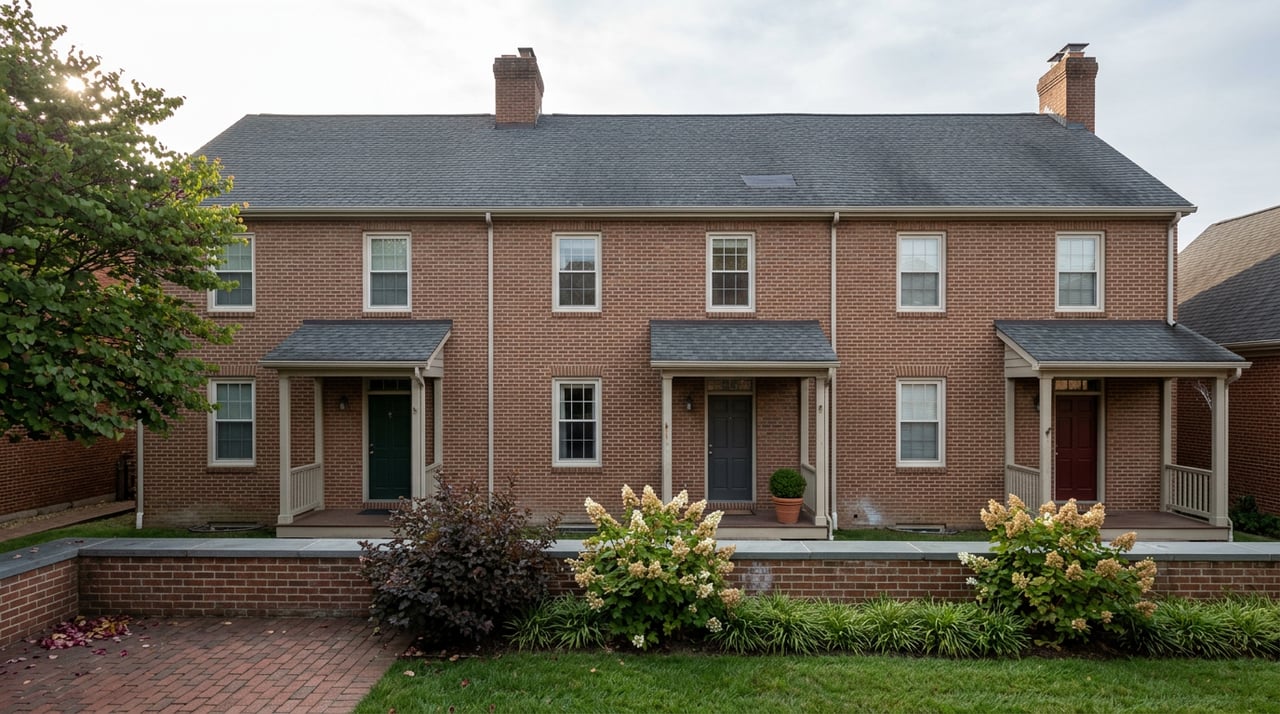
Lititz was founded in 1756 by the Moravian Church as a closed congregation town. For roughly a century, only church members could live there, and until 1855 residents leased their homes rather than owning them outright, a system built specifically to keep the settlement compact and unified under church control. That century of controlled growth left downtown Lititz built out early and built tight, block after block of stone and brick structures set close together instead of the looser, wood-frame sprawl you would expect from a town that grew on its own timeline.
That history matters right now for one plain reason. A typical hot suburb solves rising demand by building more of itself, more lots, more subdivisions, more inventory at the edges. Lititz's historic core was laid out and largely filled in before the idea of expanding to meet demand was ever part of the plan. The Wilbur Chocolate factory building on North Broad Street, once a working chocolate plant, has since been converted into shops, restaurants and residential units. That kind of adaptive reuse is functionally the only lever left to add housing inside the walkable core, squeezing new units out of old buildings rather than adding new ones.
Nationally, for-sale inventory sat 11.3 percent below pre-pandemic norms as of June 2026. In the ten ZIP codes on Realtor.com's hottest list, that shortfall widened to 60.5 percent, more than five times the national gap. Lititz didn't get unlucky into that number. Its housing stock was fixed generations before the ranking existed.
What the price is actually paying for
Here is where the ranking gets interesting instead of just impressive. According to the same coverage, the median household income in Lititz falls about 18 percent short of what's needed to afford the typical home there, assuming a 20 percent down payment and a 6.55 percent mortgage rate.
That gap is not a story about local wages falling behind. It's a story about who is actually winning the bids. Jones's research found that buyers in these top ten ZIP codes are showing up "financially prepared," with larger down payments and stronger credit profiles than the national norm, even in ZIPs where local incomes don't come close to covering local prices. Lititz sits close enough to Philadelphia, Baltimore, and Harrisburg that it draws visitors and house hunters from all three, and outside capital searching for a walkable small town with character is bidding against buyers whose paychecks are calibrated to a Lititz income, not a Philadelphia one.
For comparison, Lancaster County as a whole posted a median sold price of $385,000 in July 2026, up 6.9 percent year over year, according to Lancaster County Association of Realtors data. That's a sold price against Lititz's listed price, so the two numbers aren't a perfect match, but the gap is wide enough to make the point on its own: whatever is happening in 17543 is not simply Lancaster County's overall appreciation trickling into one more town. It's a distinct, sharper premium layered on top of it.
Not every address in 17543 carries the same scarcity
This is the part worth sitting with if you're actually comparing homes rather than reading headlines. The 17543 ZIP code doesn't stop at the borough line. It covers all of Lititz plus most of Warwick Township and Elizabeth Township, along with pieces of Manheim Township, Penn Township, Ephrata Township, Clay Township and East Hempfield Township.
That distinction changes what you're actually buying:
- Inside the historic borough, within roughly a fifteen-minute walk of Main and Broad Streets, the housing stock is genuinely fixed. Stone and brick buildings from the 1700s and 1800s don't get subdivided into new lots, and there's essentially no raw land left to build on.
- In the surrounding townships that share the ZIP code, there's more room to add homes over time, which means some of what gets counted in "17543's" hot numbers is coming from parcels that don't carry the same structural scarcity as the walkable core.
A buyer paying a premium to be inside the fixed-supply core is paying for something that can't be replicated. A buyer paying a similar premium for a home in the outer townships is paying more for proximity to the ranking than for genuine irreplaceability. Both can be reasonable purchases. They are not the same purchase, and the ranking itself doesn't distinguish between them.
What this means if you're weighing Lititz against another Lancaster County town
If you're comparing Lititz to somewhere like Ephrata, Mount Joy, or Elizabethtown, the honest way to frame the decision isn't "is Lititz worth the premium." It's "which kind of premium am I paying." A subdivision that can eventually add more inventory tends to cool as supply catches up with demand. A downtown that was fully built out before the United States existed does not have that release valve. That's a structural fact about the location, not a prediction about where prices go next month.
It also means the ranking itself is unlikely to be a one-year blip driven by a viral listing or a single good summer. The constraint that produced it, a built-out historic core inside a borough that can't annex its way to more land, was already in place before Realtor.com ever measured it. What changed in 2026 wasn't the supply. It was how visible the imbalance became once buyer demand caught up to it.
A few questions worth asking before you write an offer
Does landing on this list mean Lititz prices will keep climbing indefinitely? The ranking measures demand and pace, not a guarantee of future appreciation. What it does confirm is that the supply side of the equation in the historic core isn't expanding to meet that demand anytime soon, which is a different and more durable statement than a typical price trend.
Is every home in the 17543 ZIP code equally hard to find? No. A property inside walking distance of downtown Lititz sits on land that was built out generations ago. A property in the surrounding townships that share the ZIP code has more room around it, even if it shows up in the same headline statistics.
Will more housing eventually get built inside the historic core? The main path so far has been adaptive reuse of existing historic buildings, like the Wilbur Chocolate factory's conversion into mixed retail and residential space, rather than new ground-up construction. That pattern is likely to continue given how little raw land remains inside the borough.
If you're trying to figure out where your budget actually lands in Lititz, or how a specific address stacks up against the surrounding townships that share its ZIP code, that's exactly the kind of block-by-block read Jared Gettel can walk you through. Let's Connect and talk through what you're actually comparing before you make an offer.